Critical praise for the works of Richard C. Lyons — gathered from literary journals, review publications, and readers. Select a reviewer to read the full notice.
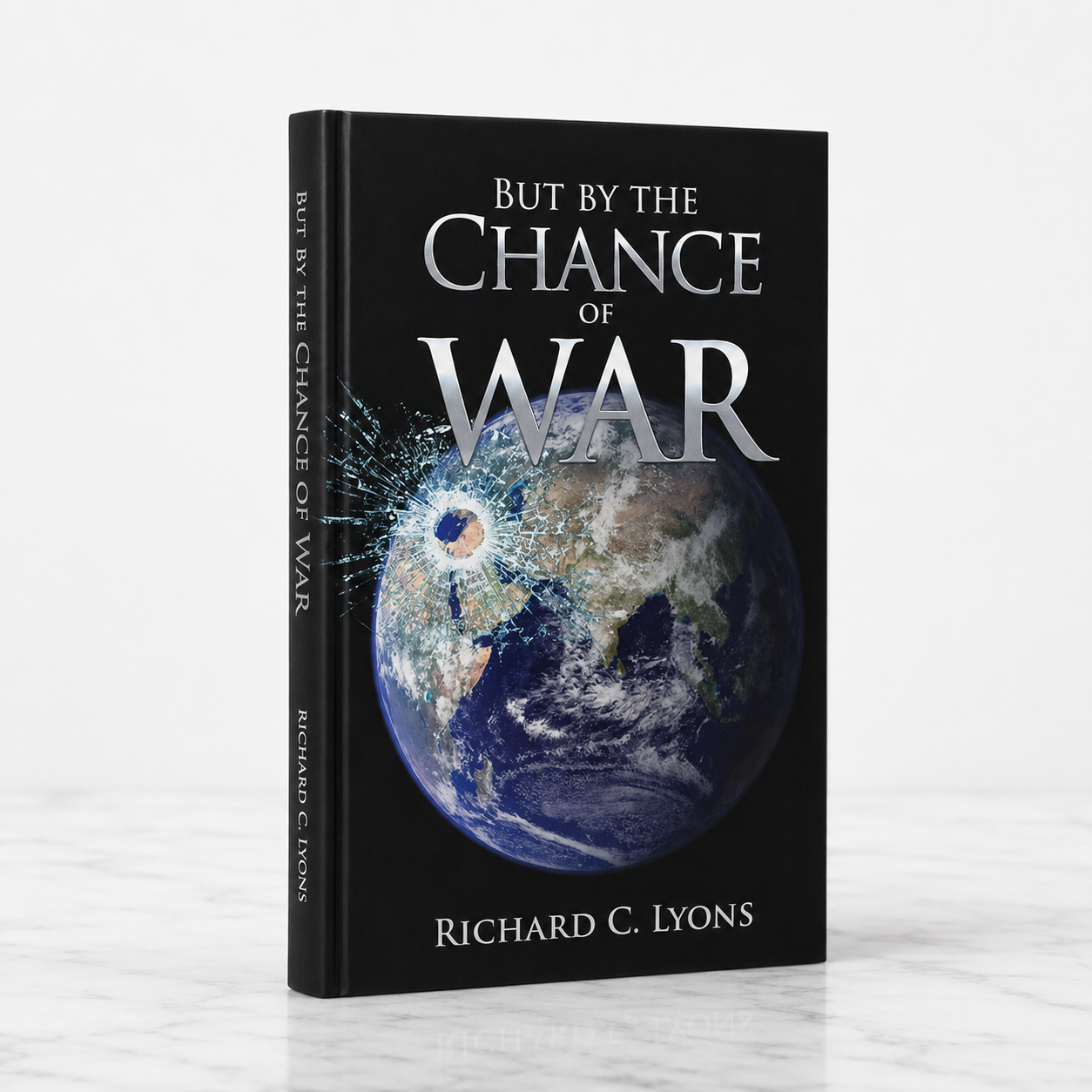
But By The Chance of War by Richard C. Lyons
Sometimes a book will challenge us to root ourselves in its meaning and venture into new psychological or emotional territories that will ultimately cause us to reflect on how we see the world. Sometimes a book will challenge us in a more basic way, through narrative and formatting, and its creative expression goads us to work hard and embrace the infinite way in which literature can be portrayed. But By the Chance of War, a new and monumental work from Richard C. Lyons, is a book that encompasses both of these aspects, presenting the reader with a truly epic journey into the expansive ability of prose while encouraging our deep reflection on the subject within its pages. The territories Lyons explores are age-old and eternally conflicting: that of mankind's historical gravitation toward war and the effects this destructive nature has continuously wreaked on society and the world throughout time.
But By the Chance of War presents four separate stories, all representing drastically different times of war and technology while also reflecting the stunted perception that has kept mankind rooted in its destructive mindset. Part One, Mathura, follows India's ancient Gupta Empire in a fierce battle against the Ephthalite Huns. The story is brought alive by the passion of the prince, Chandra Gupta, as he struggles valiantly with the weight of his newly-inherited kingship and the betrayal of those close to him. Part Two, Niagara, documents the fall of Fort Niagara from the French to the British during the Seven Years' War. Dominating the focus of the story is the stoic and determined Seneca Indian tribe, whose world has been disturbed by the armies from Europe and who must align themselves with surrender to the English after a betrayal from the French. Part Three is Amiens, which takes the reader to the trenches of the First World War where Colonel Byron Blunt strives to see the end of the war without losing another son to the fighting. Colonel Blunt's struggle takes a disastrous turn when he finds treason within his family name. Lastly, Part Four's Moriah takes us to nondescript modern times where America and Israel play central roles in a conflict that could lead the world to nuclear devastation. Perhaps the most alarming, significant and breathtaking story in the book, Moriah reflects the ultimate power struggle between mankind and most strongly evokes a sense of deep reflection from the reader as we're moved to consider what time and technology might hold for the world.
One of the most spectacular things about But By the Chance of War is the mode in which the stories are written: a system of rhyming poetry woven into the formatting of a play. Each part of the book is given its own character list, map, and set of acts and scenes with which to relay its tale while the narrative of the characters presents a marked poetic style that beguiles its reader. Between the extraordinary formatting of the book and the expanse of history it relates, the details of which undoubtedly required monumental research, it's clear to see why Lyons dedicated years of his life to the creation of this work. As with all such works, when a good deal of blood, sweat and tears goes into the making of it there's a strong likelihood that the reader will be required to devote a certain amount of perseverance to fully grasp the full concept of the book. Fascinated by the presentation of But By the Chance of War, I was enthusiastic to devote such time, to study the book and to thereby immerse myself in it most fully, and for my efforts I was greatly rewarded. But By the Chance of War is staggering and impressive, unlike anything of its kind in both scope and artist achievement.
But By The Chance of War by Richard C. Lyons
"Through fear of you Lord, the sun shines, winds blow From you Lord, life comes and fates are bestowed."
But By The Chance of War examines mankind's impulse to make war in the context of four plays that are composed entirely of verse. Readers who enjoyed The Illiad and The Odyssey will find this an interesting experience. Each of the four verse plays takes place on a different battleground in a different historic period. The first of the four plays, Mathura, begins with the joining of two great armies of India, in the year 515 C.E, to fight the Ephthalite Huns. The second play, Niagara, involves the French, the English, and the Seneca in the year 1759 at Fort Niagra between Lake Ontario and Lake Erie. The Seneca remain loyal to the French but that loyalty is not reciprocated. Amiens, the third play, is set in France in 1918 and features soldiers from Australia, New Zealand, Ireland, India, and South Africa battling the Germans in the last major offensive of World War I. Moriah, the last and shortest is set in Jerusaleum in modern times. The United States comes to the aid of Israel when an accidental nuclear blast goes off. The plays can be read at different times in any order.
At nearly 500 pages of verse covering four different historic periods, this book is not one the average reader could expect to simply read cover to cover in a few days. The stories are developed slowly, and the person who reads solely for entertainment will be disappointed, but the reader who happens to appreciate this particular classical style will find it rewarding and perhaps discover the insights the back cover promises. The more sensible approach to this opus is to be patient, exploring each within the context of a series of book club discussions or even an entire course offered to students of poetics, classical literature, history, or philosophy. An epic work of this magnitude deserves that kind of time, attention, and scholarship.
Clarion Review (5 Stars) — Review: But By the Chance of War by Richard C. Lyons
Heroic couplet-form dialogue brings an epic feel to this survey of war and human nature's destiny.
No one is more aware of the paradoxes inherent in war than its principals. In this epic survey, Richard Lyons takes to battlefields and staging areas to dramatize the tragic ironies and conflicting truths in human warfare.
But by the Chance of War is a stirring tetralogy of separate but thematically linked parts. The first three of these works are based on pivotal historical events: the invasion of the Gupta (India) Empire by the Huns (515 CE), the French and Indian surrender of Fort Niagara to the British (1759), and a German advance on British troops near the city of Amiens, France (1918). Part four is purely fictional, taking place in Jerusalem at a time very much like the present.
The dialogue is in heroic couplet, a format that, Lyons explains in his foreword, attempts "the reconciliation of two physically opposed lines." Though the poetry may seem daunting to some readers, it lends gravitas to the dialogue and smacks of classic epic works.
Each part, a play in itself, features some new advance in the technology of war, but the human element is oddly consistent. Near the end of the final cataclysmic scene in part four, nuclear warfare having decimated half the planet, a Franciscan Brother cries, "Twas for us the beast in Nature to subdue, / But it's the beast in us that subdues the world!" The lament is nearly an echo of the observation made by a Hindu priest to his Hun captors in part one: "Who would conquer all things must conquer one thing / Those desires of his soul which are limiting!"
Lyons also looks at the circumstances of war—that which is fought for and that which is defended. The Huns are "wonders of an hour" who are disrupting centuries of peace to invade the Gupta Empire. They fling "spears and stones, fire and arrows" to destroy a diverse, sophisticated culture. In Europe many centuries later, an assassination has set ten million men, most of them bound by alliances designed to keep the peace, to the trenches of World War I. The heroic sacrifice of life and limb is contrasted to betrayals of trust by nations as well as individuals. And the rage to avenge a wrong often results in the occurrence of more wrongs.
At times, Lyons's warriors argue the folly of ignoring the "gathering evil" that is the enemy. At other times, characters see that "we are all prisoners here, of our ill ambition!" His men are honorable and principled as often as they reek of excessive desire and pride. During the French and Indian Wars, the British bought newly invented howitzers from a Frenchman. Many British officers deplore the moral lapse of the traitor even though they will benefit from it; one general considers not using a cannon bought from the enemy. His argument: "This victory ought not to be merely over foes / But a victory over our lesser selves."
Richard Lyons's work is a profound examination of the phenomenon of war. It is also a proposal that men should not despair in the struggle over their "lesser selves."
Review: But By the Chance of War by Richard C. Lyons
But By The Chance of War by Richard C. Lyons is a poetic novel written in theatrical form, introducing readers to the concepts of poetic writing, war, and human nature. But By The Chance Of War consists of four chapters written as pieces in a play, each presenting a different era of war. This introduces readers to the impulses human nature brings when conflicted with the experiences of war or just the mere thought of it. Each chapter or play piece provides references such as a map, details on the location, and who is going to be present and, of course, an overview of the scene for readers to vividly create their own scenery.
The first piece begins in the year of 515 C.E. when two armies fight in India. The second piece begins in 1759 at Fort Niagara involving the French and English armies. The third piece begins in 1918 France, during World War 1 but features soldiers of many countries such as Germany, Ireland, South Africa, and Australia. The fourth piece begins in present day Jerusalem when the United States and Israel together face a nuclear blast.
But By The Chance Of War is a book that will cause readers to reflect upon emotions and expectations of how they ultimately see the world. The author offers a in-depth look into human nature and its connection to and hunger for war over time. The book is over 480 pages long, thus making it a read that cannot be rushed or skimmed due to its size and also its uniquely written style. A reader that is not interested in the theater or not familiar with poetry perhaps will not find this book for them. Readers who have studied or are interested in military history, psychology, and theatrical poetry will enjoy But By The Chance Of War immensely. Bravo, Richard C. Lyons.
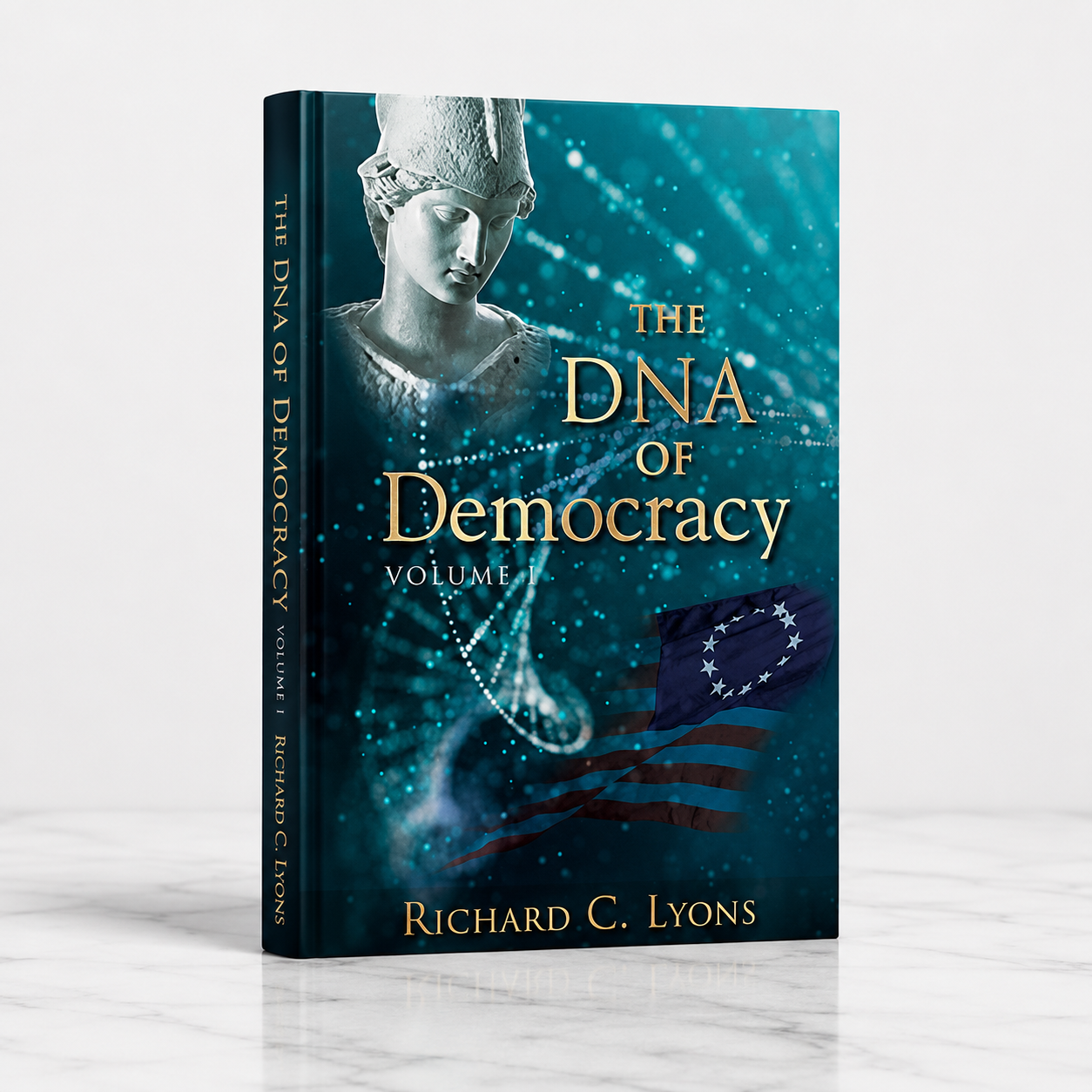
The DNA of Democracy
Author Richard C. Lyons draws on history, political philosophy and legendary stories to describe the birth of American democracy.
Starting with ancient Egypt and winding his way through Greece, Rome and medieval England, author Richard C. Lyons examines the evolution of Western democracy. He winds up in the New World with the original English colonists, reading the American Revolution and Civil War as liberating fights against tyrants and tyranny that began long before 1776.
Lyons has penned books of poetry, and it shows in his writing. His narrative is as smooth as stanzas and sometimes quite elegant, although it sometimes gets a little too flighty for its own good. However, the style is never overly ornate or academic, and it won't put off readers who are afraid that dense topics mean dense text.
It's probably fair to call Lyons a "fanboy" of democracy, and while some might accuse him of naivete, it's of the charming sort. He also shows bursts of intriguing insight, like his suggestion that the democratic structure of Parliament's Model Army helped it beat the royal forces during the English Civil War; that the history of small, independent government in the Americas helped the colonists survive the American Revolution and saw that both the North and the South had nimble, functioning administrations during the American Civil War; and his original thoughts on the symbolic significance of King Arthur's quest for the Holy Grail. But not everything Lyons writes is speculation. History buffs will have fun with Lyons's recounts of battles and anecdotes about the characters who made their way into the story of democracy. Along with the well-known names like George Washington and Benjamin Franklin, readers will find the foul-mouthed and self-aggrandizing Prussian nobleman Baron von Steuben, a mercenary who trained Washington's troops in the European style. His quip that Prussians soldiers just had to be told what to do while Americans had to be told why they were doing it succinctly captures the book's vision of the clash between autonomy and slavery.
The most blatant weakness of the book is that some readers will be left wanting more—more stories about Greece and Rome, or more looks into the legends of the cultures that shaped Western democracy, particularly the legends of the United States and the Americas. THE DNA OF DEMOCRACY is subtitled VOLUME ONE. Hopefully more volumes will further expand Lyons's enjoyable and engaging understanding of history.
Smoothly written and, at times insightfully speculative, THE DNA OF DEMOCRACY will engage poetically minded readers interested in the deep history of democracy in America.
The DNA of Democracy
Synopsis: Richard C. Lyons is an American poet whose new book, "The DNA of Democracy" is a compilation of historical vignettes that collectively discern the future of our democracy by rediscovering the combative, instructive, fascinating past of tyranny and democracy.
It seems that just as DNA is interwoven in every aspect of the human body, tyranny and democracy have their own historically distinctive DNA that have shaped our democracy today.
From Israel's Ten Commandments, to the Athenian Constitution, to Rome's Twelve Tables, to the overthrow of kings in England and America, "The DNA of Democracy" deftly traces democracy from its historical roots to the modern day, constructing a blueprint of what defines tyranny or democratic government.
"The DNA of Democracy" is a definitive guide that documents the struggle for power between tyrants and heroes across time and place. Chronicling the acts of tyrants which are expressive of tyranny's DNA, and the rebellions of heroes and the forms of law which are democracy's DNA — this study outlines the roots of democracies by telling the tales of tyrants who ironically gave them birth — births of rebellion! "The DNA of Democracy" also serves as a 'how to' contemporary guide on identifying the menace of a tyrant when you see one.
Critique: Impressively presented, "The DNA of Democracy" is extraordinarily informative and thought-provoking. A timely and valued addition to our current on-going political crisis with a polarized federal government reflecting a polarized national citizenry, and the democracy endangering activities of the Trump administration enabled by a seemingly impotent congress, "The DNA of Democracy" is an especially and unreservedly recommended addition to both community and academic library Contemporary Political Science collections and supplemental curriculum studies lists. It should be noted for students, academia, political activists, politicians, and non-specialist general readers with an interest in the subject that "The DNA of Democracy" is also available in a digital book format (Kindle, $10.95) and in an audiobook format.
Clarion Review (5 Stars) — Review: The DNA of Democracy by Richard C. Lyons
The DNA of Democracy is a thorough and praise-filled history of democracy.
Richard Lyons's political history The DNA of Democracy lauds human progression from the tyranny of ancient civilizations toward the democracies of the early twentieth century.
The book explains how absolute monarchies worked, all in service of explaining—through vignettes, battle scenes, and descriptions—how American democracy came about. Diagrams are used to illustrate the key building blocks that form the foundation, or DNA, of a successful democracy, starting with ancient Egypt's pharaohs as an example of pure tyranny.
Asserting that Israel, Greece, and Italy all possessed elements of democracy in between their despotic rulers, the book traces political progressions among tyrannical monarchs in Western Europe and the British Isles and leading up to the Magna Carta and the seeds of democratic governance. It highlights the colonies in North America as they grew dissatisfied with European leadership and worked toward a democratic ideal.
While the text focuses on a few men of power, even when praising a more general democratic process, special care is given to cover women's roles in democracy and their push for universal suffrage. Slavery is treated as an impediment to American democracy, though some of the founding fathers were slave owners. The text also points out that interactions between colonial Americans and Native Americans were driven by notions of egalitarianism on both sides.
Quotes from people as ranging as Aeschylus and George Washington on topics of democracy and tyranny pepper the work, highlighting the research and nuance behind it. Chapter openings tend toward poetics, for example referring to society as a "magical alchemy" and praising democratic behavior in a world biased toward oppression. There is some repetition because of this and fewer concrete conclusions. Such language sits at odds with the book's conveyance of historical facts and center in political commentary.
Close readings of democratic documents are included, with line-by-line analyses that show which statements, in particular, stripped power away from a few and handed it to the many. Commentary and synopses end each chapter, showcasing what their particular conflicts have to say about democracy and tyranny.
The book's illustrations—pyramids that show concentrated power at the top, representing an oppressive society—often feel superfluous, though maps of the places mentioned in the text, and tables that summarize its key principles, help with clarifications.
As drawn here, the arc of world and American history is inspiring. The book's narrative about greater and greater equality and independence feels natural and works toward a conclusion that emphasizes increasing inclusion and equality in politics.
The DNA of Democracy is a thorough and praise-filled history of democracy.
Review: The DNA of Democracy
The DNA of Democracy by Richard C. Lyons is a wonderful book for readers interested in understanding the origins, evolution, and intrinsic nature of democracy and its nuances. The author takes readers through a historical journey that begins from the faint idea of democracy from the time of the pharaohs through ancient Greece to contemporary democracies. In this book, the author explores the foundations of democracy, examines prominent democracies in history, and presents the factors that threatened some of them and that enabled the success of others. In this work, readers find an in-depth study of governments and the very core of democracy. It raises the question: Is democracy really democratic?
Richard C. Lyons offers readers a clear definition of government and speaks about the different forms of governments and transitions to look at the history of democracy. In the opening pages he notes: "When we speak of government, we may speak of definitions of tyranny and oligarchy, monarchy and aristocracy, representative republics and democracies. We may speak of titles: of emperors, empresses, kings and queens, potentates, pharaohs, generals, dictators and presidents." Deeply researched and filled with historical references, The DNA of Democracy offers a fresh perspective on the idea of democracy and valuable information that enables readers to understand the historical evolution of democracy, the challenges it has faced throughout history and what the future democracy may look like. It is a critical work that comes across as a vital reference to historians, students of political science and anyone interested in the art of governance. This book is intelligently written, well researched, and filled with fascinating ideas.
Review: The DNA of Democracy
A comprehensive analysis of democracy and its ideals since inception doesn't immediately sound like a riveting read, but The DNA of Democracy by Richard C. Lyons is like no other history, work of anthropology, or political science book you've read before. With an informal voice and the ability to never take the subject too seriously, Lyons presents an impressive and insightful look at the trials and tribulations of human societies as we've attempted to find purpose and make peace.
The scale and scope of this book are initially daunting, but Lyons lays out an intuitive framework and explains the angle he hopes to take in the book. By drawing parallels between the entangled nature DNA and the intrinsic presence of both tyranny and democracy throughout history, he provides an accessible entrance to a typically challenging subject. There isn't a huge market for cross-disciplinary historical texts outside of certain academic niches, but in the same spirit as Jared Diamond and Yuval Noah Harari, Lyons outlines complex subjects in digestible portions.
Lyons' study has a particular focus on tyrants, the historical events that led to their rise, and their eventual fall from power, which makes the book feel particularly timely given the recent swell of nationalism and a resurgence of strongmen coming to power across the world. The depth of research and peripheral history around certain time periods is highly compelling, and there's simply no way to read this book and not walk away with a richer understanding of humanity's past.
Lyons hasn't written a comprehensive new history, but rather an abridged version through the lens of democracy, containing only the most interesting and critical moments. Taking anecdotal snapshots from Israel, Greece, Egypt, Rome, and many other ancient cultures, readers are led by the hand through the rise and fall of empires, while key markers along the way – both good and bad omens – are pointed out and their significance is explained.
As the course of history moves into Europe and the divine right of kings becomes an even more prominent source of human misery, readers will begin to recognize the signs of rot that have afflicted so many tyrants and cruel dominions. The patterns are laid out clearly, and rarely has the phrase "history repeats itself" been so prescient. Remarkably, the casual nature of the author's storytelling style makes this a thoroughly enjoyable read, despite the density of information and the nearly 400 pages.
At times, Lyons' informal style undercuts his own authority on the subject. His recounting of certain historical interactions should stand alone, without his offhand commentary or attempts at subtle humor. There is an appropriate time for his sardonic commentary, and it should occasionally have been reined in further. That being said, this is an academic text like no other, leading readers towards profound realizations and laughter at the same time. As a work of popular history, the book most certainly succeeds.
Given the world around us, and the tumultuous 21st century thus far, this book serves as a reminder that there are signs along the long path of history to which we can refer, as well as essential forks in that road that will lead us towards salvation or suffering. Lyons captures the reader's imagination with The DNA of Democracy in a way that few books of this genre can.
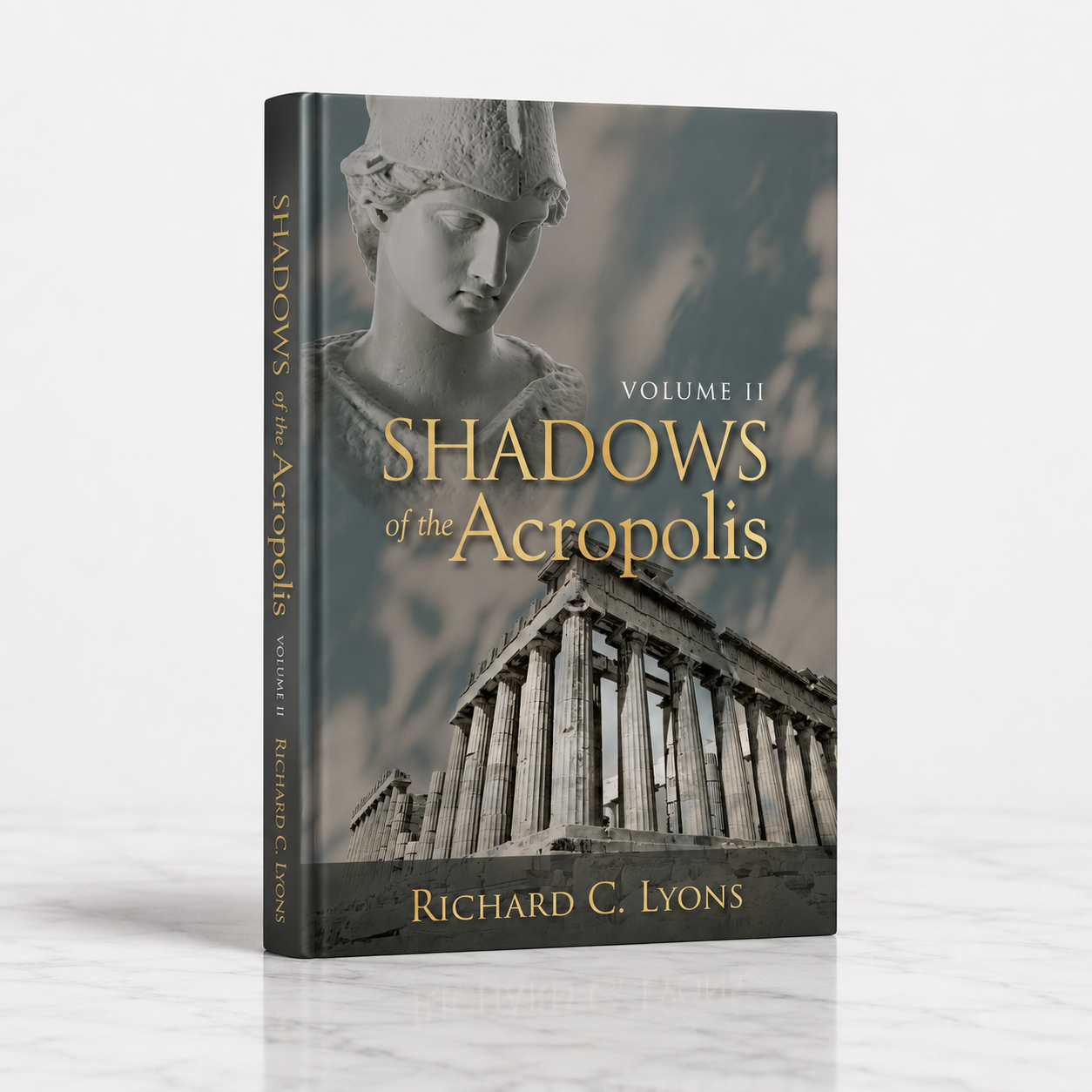
Review: Shadows of the Acropolis
An eye-opening examination of government control and a power-hungry shift away from the US constitution. Check out what Toni Woodruff has to say about this indie politics book.
Review: Shadows of the Acropolis
Shadow of the Acropolis, is an eye-opening look at the historical background of what Lyons calls a "hybrid nation," which will catch most readers' attention. This book is insightful for those who are keen on history and politics.
Review: Shadows of the Acropolis
An eye-opening examination of government control and a power-hungry shift away from the US constitution.
Review: Shadows of the Acropolis
Lyons' political treatise asserts that growing federal power and bureaucracy have undermined the Constitution, social cohesion, and individual liberty. Lyons' manifesto is a rebuke to big government and a paean to conservative values of faith, religion, individualism, free enterprise, and loyalty to what he sees as the Framers' constitutional vision. His dissections of political philosophy are cogent and discerning, and his analyses of concrete policies are well thought out, employing elegantly aphoristic prose.
Review: Shadows of the Acropolis
(Lyons) makes his case with clarity and power…highlighting abuses of a growing government…throughout Lyons charts the growth of "Leviathan."
Review: Shadows of the Acropolis
Shadows of the Acropolis (Volume II) is your gateway to discover important political information. This book thrives in its excavation of governmental power and control.
Richard C. Lyons cuts through the muddy waters of government influence to bring you historical facts that may alter your understanding of America forever. This is not your typical US history book.
Review: Shadows of the Acropolis
Richard C. Lyons' Shadows of the Acropolis is an insightful, enlightening, and magnificent work. This is a must-read for enthusiasts of political, historical, and philosophical works.